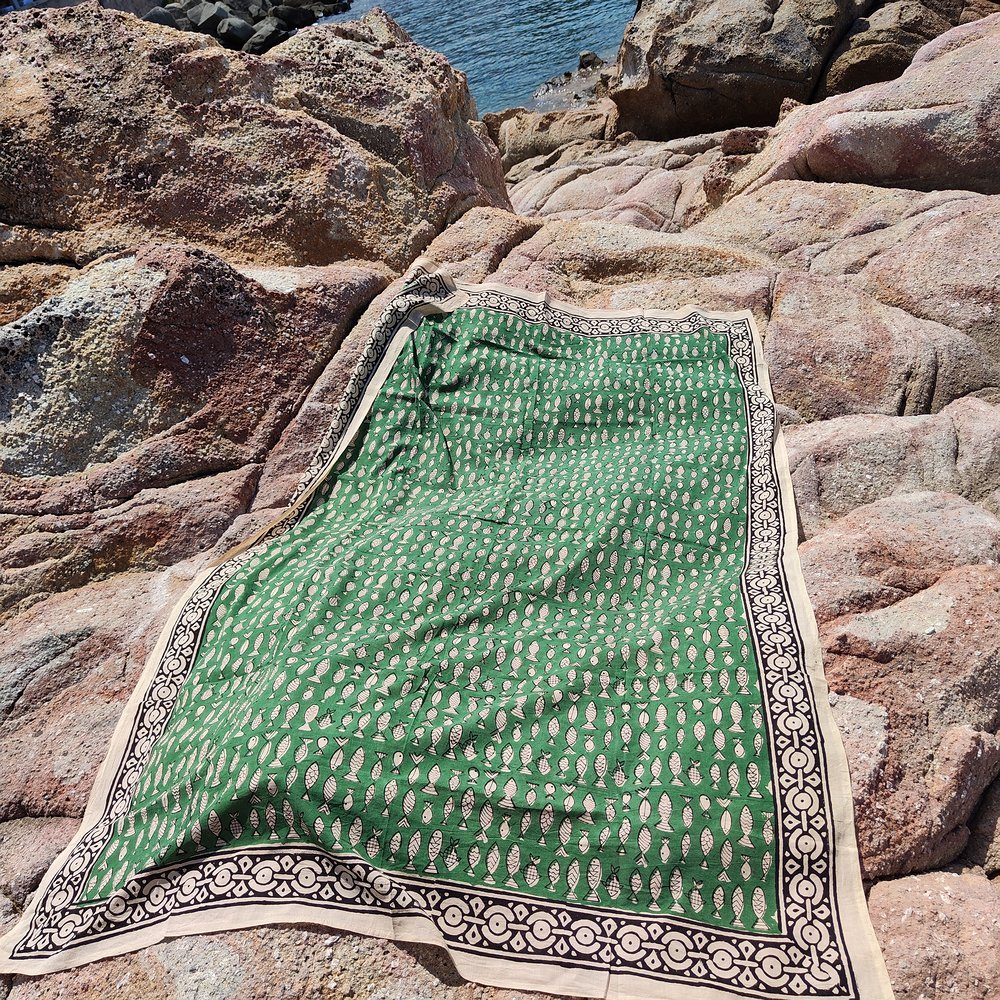
NIGUN cotton sarong with tribal patterns. The designs that decorate the sarong are made with handcrafted wooden stamps. A typical and traditional Indian craftsmanship for the ideal sarong for your summer. This is also a multi-purpose, adaptable and easily wearable accessory.
The stamping of the patterns and the production of the wooden stamp are entirely handmade. Furthermore, for multi-colored motifs, the printing process is done once for each color: this means that for a 3-color motif, the fabric is printed 3 times over the entire surface.
Moreover, this cotton sarong with tribal patterns can also be used as a sarong, which is a large piece of cotton draped around the waist and worn as a skirt by men and women in many parts of Asia.
The fabric is often dyed with bright natural colors, or printed not only with complex motifs depicting animals or plants but also checks and finally with various geometries and patterns.
This type of sarong is ideal to wear as
- skirt cover-up
- dress cover-up
- tube dress cover-up
- one-shoulder dress
- beach towel
- wall hanging (ethnic decoration)
- summer and/or winter scarf
- all-purpose cover
- summer baby wrap
Discover all the specifications of this NIGUN cotton sarong with tribal patterns!
Dimensions
- length in cm: 185-190 (varies from piece to piece)
- width in cm approx: 117-122 (varies from piece to piece)
- weight in grams approx: 120
- material: 100% cotton
- origin: India
- workmanship: loom / hand-printed
Block print: a handmade craft repeated by hand
Each sarong and each scarf is created through a traditional process in which the pattern is transferred onto the fabric with hand-carved and hand-printed wooden blocks.

The work begins with the preparation of the tools and carved blocks, each designed to leave a part of the design on the fabric.

The fabric is prepared and laid out on the workbench: a simple base, ready to receive color, rhythm, and repetition.

The block is then imprinted by hand, one step after another. The continuity of the pattern comes from the artisan's eye and experience.

Finally, the fabrics are inspected, dried, and prepared. Small variations are not defects: they reflect the authentic character of handmade craftsmanship.