Auspicious Symbols in Oriental Jewelry: A Guide to Their Meanings
In short:
- Auspicious symbols in Eastern jewelry are emblems of good fortune that reflect ancient spiritual and cultural values. They attract luck, protection, and balance through shapes and materials with precise meanings. The choice of the appropriate symbol and material intensifies the positive and spiritual effect of each worn piece.
Auspicious symbols in Eastern jewelry are emblems of good fortune that embody ancient spiritual and cultural values, worn to attract luck, balance, and protection. In Asian tradition, these signs are not mere decorations: every shape, every stone, and every engraving carries a precise message. From the Tibetan lotus flower to Chinese jade, from Malas with red coral to rings with Ganesha in 925 silver, auspicious Eastern jewelry symbols combine aesthetics and intention in a single object. This guide explains the most important meanings, the materials that amplify them, and how to choose the right piece for yourself or as a gift.
What are the main auspicious symbols in Eastern jewelry?
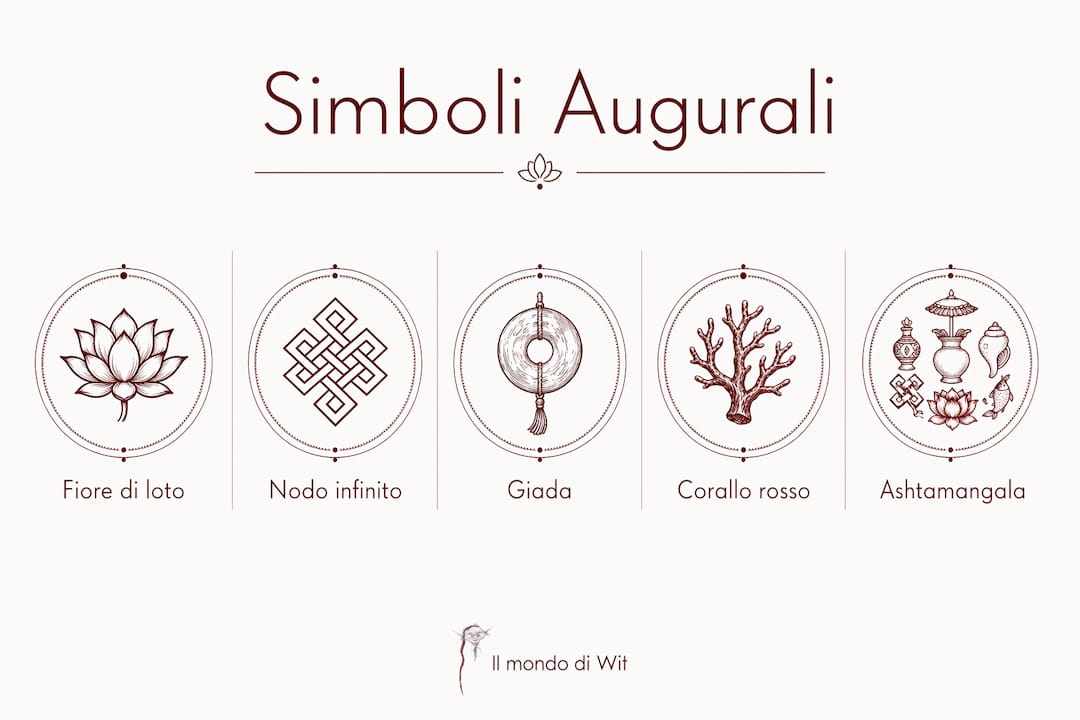
The most common auspicious symbols in Eastern jewelry come from Tibetan and Buddhist traditions. The Eight Tibetan Auspicious Symbols, known as Ashtamangala, are the most complete symbolic system in Asia: each element has a specific function and a distinct message.
The Ashtamangala symbols are:
-
Parasol (protection from evil and suffering)
-
Golden Fish (happiness and freedom from the cycle of pain)
-
Conch Shell (spiritual awakening and spread of the Dharma)
-
Lotus Flower (purity of mind and body)
-
Endless Knot (harmony and interconnectedness of all things)
-
Dharma Wheel (stability, teaching, and spiritual path)
-
Vase of Treasure (abundance, success, and prosperity)
-
Victory Banner (strength and triumph over obstacles)
These eight signs attract good fortune and remove obstacles in daily life. The difference compared to a simple passive amulet is substantial: Tibetan symbols act as active tools that direct the mind towards a precise purpose.
The lotus flower deserves special mention. Present in almost all Asian traditions, the lotus grows in mud but blossoms immaculately. This visual contrast makes it the perfect symbol of spiritual purity achieved through life's difficulties. In jewelry, the lotus often appears as a pendant, an engraving on rings, or a central motif on silver bracelets.
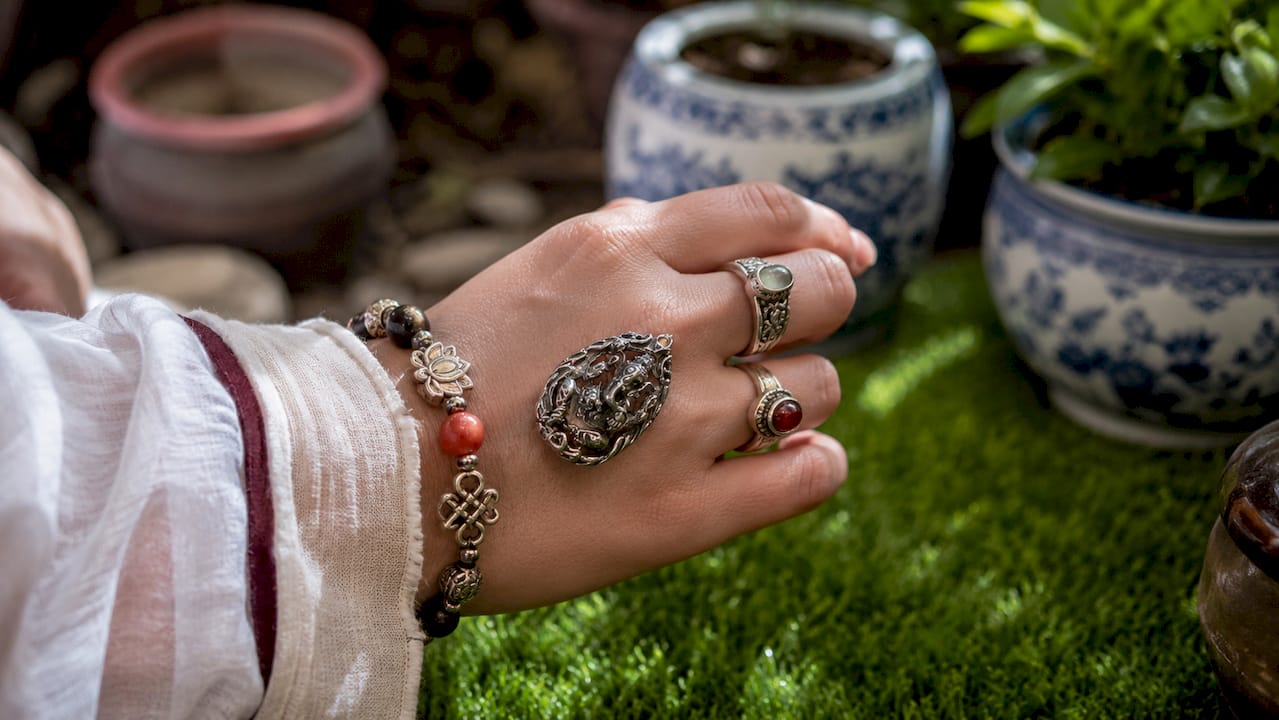
Pro tip: If you are looking for a single-symbol piece of jewelry to wear every day, the Endless Knot is the most versatile choice. It represents the harmony among all life forces and does not belong to a single religious tradition, making it suitable for anyone.
How materials and culture amplify the meaning of Eastern jewelry
The material of an Eastern jewel is never neutral. In Chinese tradition, jade is as valuable as gold: Confucius attributed eleven virtues to it, including benevolence, fidelity, and sincerity. This makes it the stone most imbued with moral meaning in the entire history of Asian jewelry.
A little-known detail: in ancient China, jade was mortared into the foundations of houses to protect and consolidate the family. A visible imperfection on the stone was not considered a defect, but a sign of honesty and sincerity. This reversal of the concept of perfection is typically Confucian: virtue matters more than outward form.
| Material | Tradition | Auspicious Meaning |
|---|---|---|
| Jade | Chinese and Taoist | Virtue, protection, family prosperity |
| Red Coral | Tibetan Buddhism | Protection, vital energy, opening of the heart |
| Turquoise | Tibetan Buddhism | Revitalization, balance of subtle energies |
| Lapis Lazuli | Hinduism and Buddhism | Wisdom, mental clarity, spiritual connection |
| 925 Silver | Widespread ethnic tradition | Purity, energy conduction, base for sacred symbols |
Red coral in Tibetan Buddhism is considered a sacred protective stone that stimulates vital energy and opens the heart to love. In traditional Tibetan Malas, which have 108 beads to represent the passions to overcome towards enlightenment, coral and turquoise appear together precisely to balance protection and spiritual openness.
Pro tip: When choosing a piece of jewelry with natural stones, verify that the material is consistent with the engraved symbol. A lotus on jade reinforces the message of moral purity; an Endless Knot on coral adds a protective dimension that the symbol alone would not have.
To delve deeper into the meaning of stones in ethnic jewelry, the tradition is much richer than it appears at first glance.
How to choose jewelry with auspicious symbols based on your intentions
Choosing symbolic jewelry always starts with intention. The spiritual meaning of the jewelry depends on the intention of the wearer or giver: each piece becomes a personal and lasting talisman only when there is a conscious connection between person and symbol.
Choosing well means following a four-step process:
-
Identify your primary need. Are you looking for protection, mental clarity, prosperity, or emotional balance? Each symbol addresses a different need. The Dharma Wheel helps those seeking stability and direction; the Vase of Treasure is for those working on concrete goals of abundance.
-
Match the symbol with the right material. A Ganesh pendant in 925 silver combines the protective power of the deity with the conductive purity of silver. Ganesh is the Hindu deity who removes obstacles: wearing him means declaring the intention to overcome difficulties with grace.
-
Respect the cultural context. Sacred symbols such as the Dharma Wheel or the Endless Knot come from living traditions. Wearing them consciously, knowing their meaning, is an act of respect towards those cultures. Wearing them as mere decoration without knowing their origin diminishes their symbolic power.
-
Consider the jewelry as a gift. A spiritual piece of jewelry as a gift carries a message of care and protection for the recipient. Choosing the right symbol for the right person is a gesture of deep attention. A Ganesh ring for someone facing a significant challenge, a lotus for someone seeking personal rebirth: the symbol speaks even when words are not enough.
Symbolic jewelry functions as a daily psychological ally. Every time it is touched or seen, it recalls the original intention with which it was chosen. This mechanism of mental anchoring is documented in cognitive psychology and precisely reflects what Eastern traditions have always known.
How do auspicious symbols vary among different Asian cultures?
The same symbol changes meaning depending on the culture that interprets it. The lotus flower is the clearest example of this variation. In Thailand, it is an object of religious devotion, offered in temples as an act of daily faith. In Japan, it becomes a philosophical and artistic symbol, linked to impermanence and the beauty of the present moment. In China, the lotus is a moral emblem of purity and integrity, cited by Confucian scholars as a model of upright living.
This variation does not weaken the symbol. It enriches it. A lotus pendant carries all these layers of meaning simultaneously, even if the wearer knows only one.
Buddhist symbols have naturally found their place in contemporary jewelry. Artisans from Nepal, Tibet, and India reinterpreted them in 925 silver, combining them with natural stones like lapis lazuli, turquoise, and onyx. The result is pieces that maintain the authenticity of the original symbol but adapt to modern aesthetics. Artists and galleries like HD Asian Art document this continuity between tradition and contemporary production in Asian art.
The challenge of contemporary design is to preserve the meaning without emptying the symbol. A stylized Endless Knot on a minimalist ring retains its power if the wearer knows the message it carries. The form can change; the intention must remain intact.
Key Points
Auspicious symbols in Eastern jewelry combine form, material, and intention into an active symbolic system that goes far beyond simple decoration.
| Point | Details |
|---|---|
| Ashtamangala are active tools | Tibetan symbols are not decorative: they remove obstacles and guide the mind towards concrete goals. |
| Material amplifies the symbol | Jade, coral, and turquoise add a layer of spiritual meaning that reinforces the message of the engraved symbol. |
| Intention determines value | A symbolic jewel becomes a talisman only when the wearer knows and shares its meaning. |
| The lotus varies across Asian cultures | In Thailand it is devotion, in Japan philosophy, in China moral virtue: the same symbol carries different layers of meaning. |
| Cultural respect is part of the jewelry | Knowing the origin of a sacred symbol is an act of respect that preserves and amplifies its power. |
The value one wears
I have worked with ethnic and symbolic jewelry for years, and the most common question I hear is: "But do they really work?" The honest answer is that it depends on what you mean by "work."
An auspicious symbol does not change external reality. It changes how one relates to it. When I wear a piece of jewelry with a symbol I know and respect, that piece becomes a physical reminder of an intention. The Dharma Wheel on my wrist reminds me to seek stability. The lotus around my neck brings me back to the idea that beauty emerges from difficulty. This is not mysticism: it is applied psychology with three thousand years of history.
What I find fascinating, and what most articles on this topic ignore, is the role of imperfection. In the Chinese tradition of jade, a visible flaw in the stone is a sign of sincerity, not a defect. This philosophy should also guide the choice of jewelry: don't look for the perfect piece, but the authentic one. A handcrafted piece of jewelry with a small irregularity carries more history and more intention than an industrially polished piece smoothed to anonymity.
The conscious choice of symbolic jewelry is already a spiritual act in itself. You don't need to believe in anything specific. You just need to know what you are wearing.
— The world of Wit
Jewelry with auspicious symbols on Il mondo di Wit
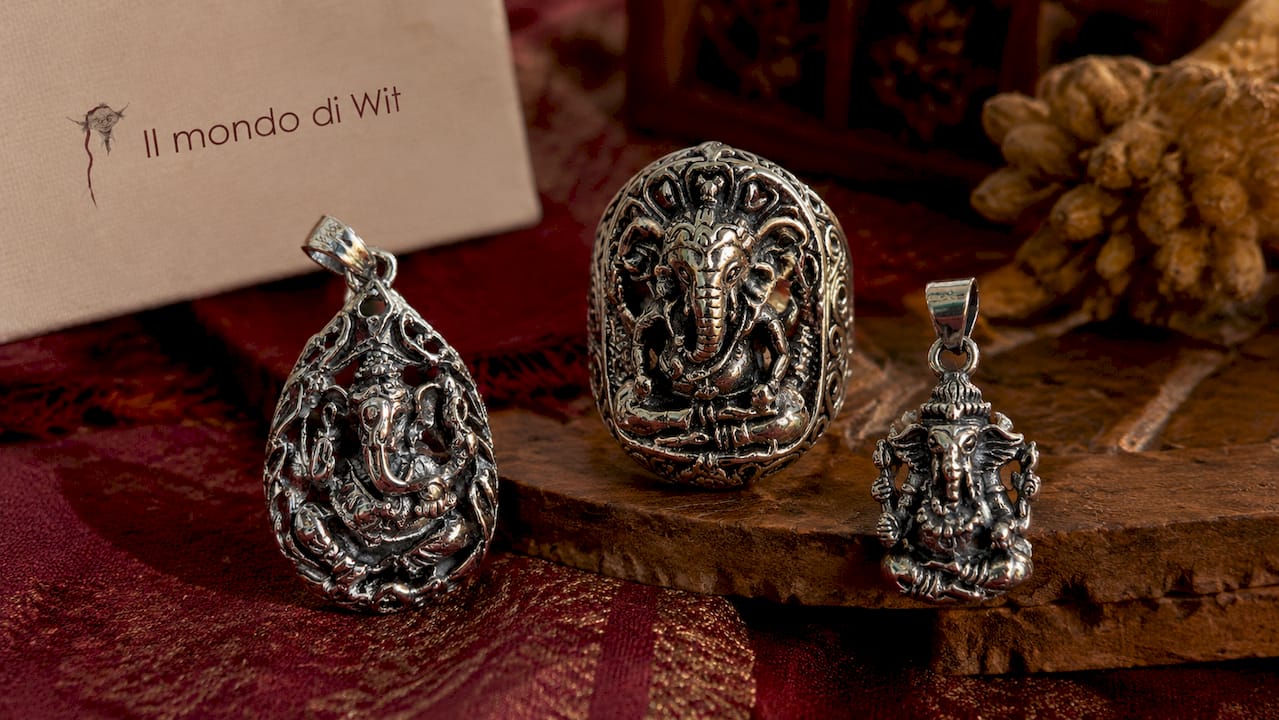
Il mondo di Wit selects handcrafted ethnic jewelry in 925 silver with protective and auspicious symbols from Hindu and Buddhist traditions. Among the most requested pieces are the Ganesh NAWA pendant and the Ganesh JHOBLA pendant, both made of hand-worked 925 silver. For those who prefer a ring, the Ganesh GANAPATI ethnic ring combines symbolism and craftsmanship in a piece for everyday wear. Each piece of jewelry originates from a precise tradition and carries an authentic auspicious meaning. The complete collection of handcrafted ethnic jewelry is available online with detailed descriptions for each symbol.
Frequently asked questions
What are auspicious symbols in Eastern jewelry?
Auspicious symbols in Eastern jewelry are signs of good fortune from Buddhist, Hindu, and Taoist traditions, used to attract protection, prosperity, and harmony. The Tibetan Ashtamangala are the most complete system, with eight distinct symbols covering every aspect of spiritual life.
What is the most popular good luck symbol in Eastern jewelry?
The lotus flower is the most widespread auspicious symbol throughout Asia, present in jewelry from China, Japan, Thailand, and India with variations in meaning ranging from moral purity to religious devotion.
Why is jade considered precious in Chinese culture?
Jade is considered as precious as gold in Chinese culture because Confucius attributed eleven moral virtues to it, including benevolence, fidelity, and sincerity. In ancient China, it was also mortared into the foundations of houses as protection for the family.
How do you choose jewelry with auspicious symbols as a gift?
The best choice starts with intention: identify the person's need, match the right symbol, and choose a material consistent with the message. A Ganesh pendant is ideal for someone facing a challenge, while a lotus suits someone seeking rebirth or inner clarity.
Do Tibetan Malas have a specific meaning in the number of beads?
Traditional Tibetan Malas have 108 beads, a sacred number that represents the passions to overcome to achieve enlightenment. The chosen materials, such as coral and turquoise, add specific spiritual properties related to protection and energy balance.