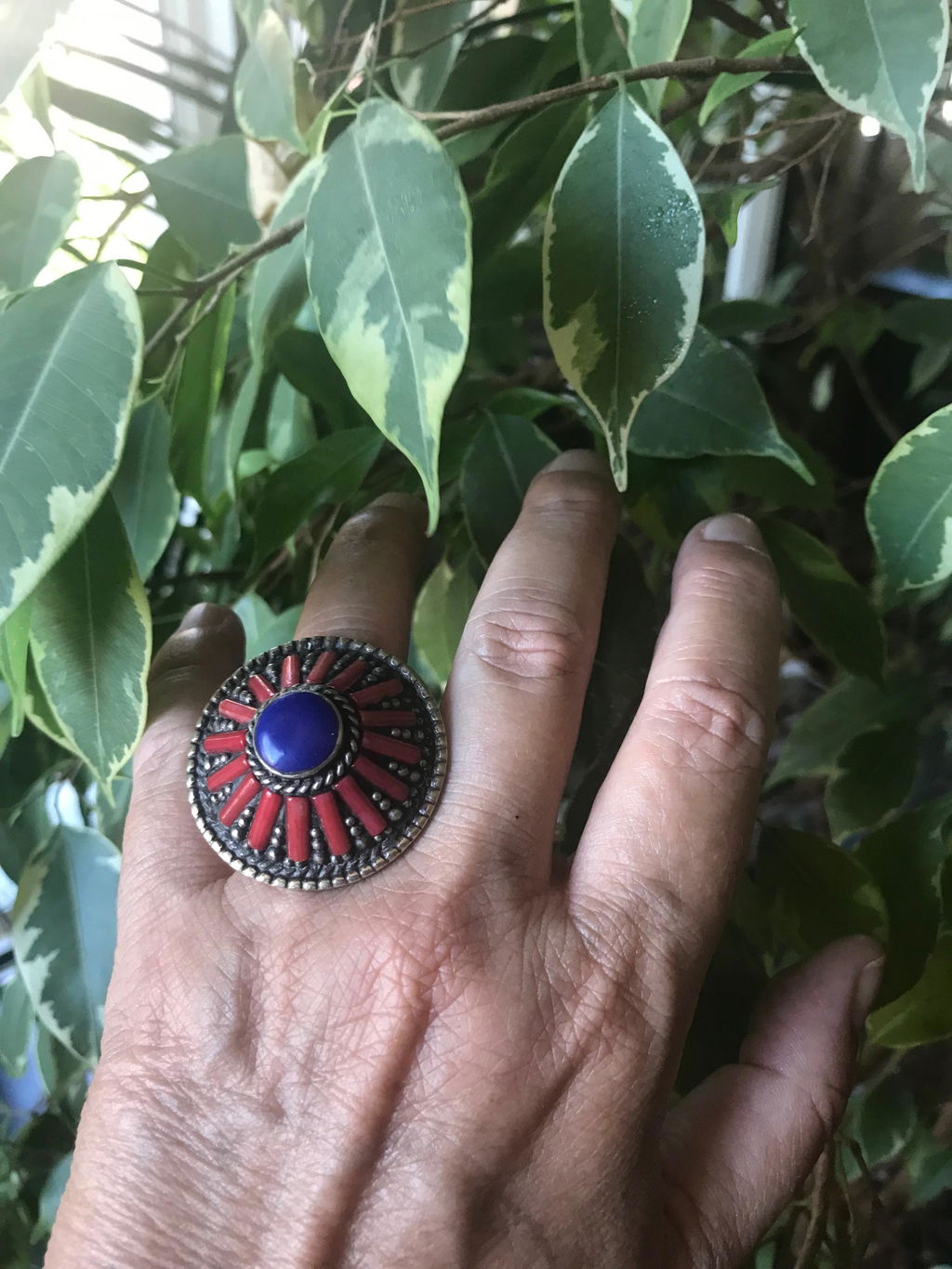
Ring handcrafted in 925 silver. Such craftsmanship is a typical creation of North Indian jewellery.
Typical are ornamental elements made one by one by hand. Stippling, filigree, floral petals, depictions of peacocks, elephants, tigers and snakes are part of typical Indian ethnic jewellery.
Ethnic design depiction of a DORJE
The set stone is a TURQUOISE
The ring is made of hypoallergenic 925 silver. Its surface is not treated or plated therefore it guarantees its beauty over the years.
Meaning of DORJE - VAJRA
L dorje (in Tibetan), vajra (in Sanskrit) is a tantric ritual tool used in Tibetan and Indian Buddhist practices.
The dorje (vajra) symbolizes the union of method and wisdom, the cornerstone of Buddhist practice, the cause of liberation from the mental obscurations that afflict humanity.
The word dorje ( vajra ), also means lightning and diamond .
Lightning illuminates the darkness of the night, so the Dharma (the teaching of Buddha ) dispels the darkness of ignorance.
The hardness of the diamond symbolizes the perseverance of the practice which brings out the pure nature of the mind, which, like the precious gem, cannot be contaminated by temporary impurities.
The dorje (vajra) has a scepter shape and is used in Buddhist bell rituals. The dorje (vajra) is held in the right hand while the bell in the left hand.
The dorje (vajra) and the bell together symbolize the feminine and masculine, the opposites and their integration.
The mudras (symbolic gestures used in various religions) of the embrace, which crosses the dorje (vajra) and the bell on the chest, symbolizes the union of method and wisdom that integrates the understanding of the two aspects of reality:
interdependent origination (relative reality) and emptiness (ultimate reality).
The structure of dorje (vajra) symbolizes other aspects of the Buddha's teaching: the spherical ends represent sunyata (base or primordial aspect of the mind) and its aspect in temporal manifestation (everyday life)
The mirrored form of the dorje (vajra): two lotus flowers coming together represent the union of the two worlds (Samsara and Nirvana).
The petals represent the four Bodisatva .
The three central circles of dorje ( vajra ) represent the bliss achieved by the Buddha spontaneously, without effort and symbolize the six perfections (the six Paramites) that lead to liberation ( Ethics , Generosity , Patience , Perseverance , Meditation And Wisdom ).
The shape of the double dorje (vajra), known as Vishavavajra, is used as a seal on important scriptures, and is often placed at the base of statues depicting the main Tibetan and Indian deities. The dorje (vajra) is also used as the center of some mandalas.
If worn, it reminds us of the positive qualities and potential of our mind, of which the dorje (vajra) is its symbol, and is a warning not to waste our existence.
Specifications
- strong point: close-fitting to the finger, domed 3D effect, wide band,
- provenance: Own production
- Processing method: artisanal
- Stone(s): TURQUOISE
- Surface: polished
- Material: 925 silver
- SKU: anag661
Measures
-
Size: 16
- A - upper part thickness in mm: 6
- B - upper part width in mm: 18
- C - upper part length in mm: 24
- D - diameter of the upper part in mm: -
- E - width of the band in mm: 3
- F - thickness of the band in mm: 1
Consult our dedicated page to the measurements to find yours. Consider that a wide band ring can be a little larger than the size you usually wear because it covers the entire phalanx, furthermore we always have one hand smaller than the other.