African Tribal Jewelry: History, Symbols, and Culture
In short:
- African tribal jewelry are artifacts with social, spiritual, and identity functions, produced by ethnic communities. The primary technique is lost-wax casting, which ensures unique and high-quality pieces. Today, they are reinterpreted as symbols of identity, empowerment, and sustainable fashion, while maintaining a strong cultural connection.
African tribal jewelry are defined as ornamental artifacts with social, spiritual, and identity functions, produced by ethnic communities of the African continent using techniques passed down for millennia. The history of African tribal jewelry is not just about aesthetics: each piece tells a story of values, belonging, and moments in life. From the wreck of the Whydah Gally, which yielded over 300 Akan gold objects, to the Samburu mporo necklaces of Kenya, African goldsmithing demonstrates a technical and cultural complexity that many still underestimate.
What are the historical origins of African tribal jewelry?
African goldsmithing has documented roots in very ancient times. Analyses of artifacts from the Whydah Gally wreck, which sank in 1717 off the coast of Massachusetts, revealed naturally pure gold without systematic adulteration, with very low copper content and natural silver compatible with West African deposits. This data directly dismantles colonial myths that described Akan gold as impure or of inferior quality.
The most widespread technique among the Akan of Ghana and Ivory Coast was lost-wax casting. The process involves molding an object in wax, covering it with clay, heating it to melt the wax, and pouring molten metal into the mold. The result is a unique, irreproducible piece. Modern compositional analyses confirm that this technique produced objects of comparable quality to contemporary European goldsmithing.
The materials used in the history of African jewelry vary enormously by region and historical period:
- Gold: dominant in West Africa, especially among the Akan
- Silver: widespread among the Tuareg of the Sahara and the peoples of the Maghreb
- Glass beads: imported or locally produced, used throughout sub-Saharan Africa
- Bone, ivory, and wood: accessible materials used in rural communities
- Natural stones: turquoise, lapis lazuli, carnelian, with precise symbolic meanings
Pro tip: When observing an ancient African jewel, look at the surface: the marks of lost-wax casting leave an irregular and organic texture, very different from the mechanical perfection of modern industrial pieces.
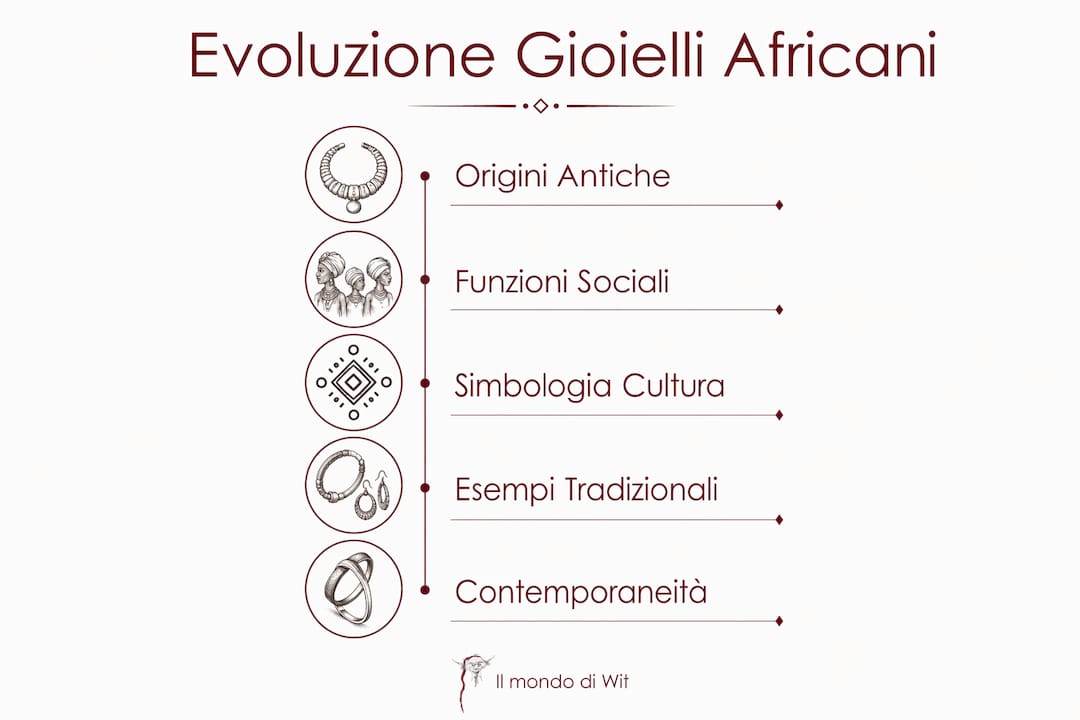
What cultural significance do African tribal jewelry hold?
Traditional African jewelry communicates social hierarchies, ethnic belonging, and rites of passage. A young Maasai warrior wears different ornaments than a village elder. A bride wears necklaces that signal her new status. These objects don't just decorate: they declare.

The meaning of tribal jewelry operates on multiple levels. The first is social status: the quantity and quality of jewelry indicates wealth, power, or rank. The second is ethnic belonging: each group has recognizable shapes, colors, and materials. The third is spiritual protection: amulets and talismans are integrated into bracelets, necklaces, and rings to ward off evil or attract good fortune.
Among the values conveyed by African jewelry, some concrete examples:
- Akan gold weights represent equality and justice through geometric and figurative forms with codified names and meanings
- Samburu mporo necklaces signal the bond between a woman and her partner, but also her role in the community
- Tuareg rings bear crosses that indicate the wearer's city of origin, functioning as a geographical identity card
- Leather amulets from East Africa contain protective verses or symbols sewn inside
Regional differences are marked. West Africa favors solid gold and elaborate forms. East Africa uses colorful beads in combinations with precise color codes. The Sahara and North Africa prefer worked silver with filigree and blue or green stones. Every material choice is a cultural choice.
How tribal jewelry reflects specific traditions: practical examples
Akan gold weights: an economic and cultural system
Akan gold weights, also known as goldweights, are small bronze objects used to measure gold dust in commercial transactions. Each weight has a name, a value, and often an associated proverb. This makes them simultaneously economic tools, oral archives, and cultural symbols.
There are sets of weights with dozens of different values, and the names vary between regions. A bird-shaped weight can symbolize wisdom. A crocodile-shaped one can evoke a proverb about justice. The culture of Akan African jewelry demonstrates that an ornamental object can also be an economic infrastructure and an ethical code.
Samburu mporo necklaces: from relational symbol to instrument of autonomy
The mporo necklaces of Samburu women in Kenya are traditionally linked to marital status. A woman receives the necklace from her partner as a sign of belonging and recognition. The meaning is precise and public: the wearer is recognized by the community.
In Umoja, a Kenyan village founded by Samburu women who survived violence, mporo necklaces have taken on a new meaning. The women independently purchase beads and produce jewelry to sell to tourists. Traditional jewelry becomes a source of income and a symbol of independence. This is one of the clearest examples of how a cultural object can change meaning without losing identity.
| Tradition | Original function | Contemporary function |
|---|---|---|
| Akan gold weights | Commercial measure and ethical code | Museum object and cultural symbol |
| Samburu mporo necklaces | Marital status and belonging | Economic autonomy and female identity |
| Tuareg silver/brass crosses | Geographical identity and protection | Ethnic jewelry and cultural connection |
Pro tip: If you want to understand an African jewel, first ask which ethnic group it comes from and at what time of life it was worn. The context changes everything.
How have African ethnic jewelry evolved in contemporary times?
Traditional African jewelry today lives a dual life. In their communities of origin, they maintain ritual and social functions. In African cities and the diaspora, they become tools for identity affirmation in global contexts.
The contemporary evolution of African jewelry follows three main directions:
- Urban reinterpretation: African designers, such as those from the Lagos, Accra, and Nairobi scenes, use tribal forms in contemporary materials, creating pieces that engage with international fashion without abandoning their roots
- Economic empowerment: artisan cooperatives, especially women's, produce ethnic jewelry for global markets, transforming tradition into concrete livelihood
- Diasporic identity: in African communities in Europe and the United States, wearing traditional jewelry is a political and cultural act, a way of asserting belonging in contexts that tend towards homogenization
Ethical and artisanal fashion has given new visibility to these objects. The slow fashion movement values unique handmade pieces over mass production, and African jewelry fits perfectly into this logic. Each piece carries a verifiable story, a real artisan, an ancient technique.
However, there is a risk. When African tribal jewelry is industrially produced and sold as "ethnic" without a real connection to the communities of origin, the meaning is lost. The difference between an authentic jewel and a decorative copy lies in the production chain and respect for traditions. Organizations like Onlus Soleil d’Afrique work to support African artisan communities, ensuring that economic value remains close to those who produce.
The ethnic jewelry trends in 2026 confirm a growing interest in pieces with documented provenance and verifiable cultural meaning. The discerning consumer doesn't just buy a beautiful object: they buy a real story.
Key points
African tribal jewelry are complex cultural systems that combine advanced goldsmithing techniques, social codes, and spiritual meanings layered over time.
| Point | Details |
|---|---|
| Documented historical origins | The Whydah wreck confirms advanced techniques and pure gold among the Akan as early as the 18th century. |
| Materials with precise meaning | Gold, silver, beads, and stones are not aesthetic choices: each material indicates culture and context. |
| Social and spiritual function | African jewelry signals status, ethnic belonging, and protection, not just adornment. |
| Emblematic examples | Akan gold weights and Samburu mporo necklaces show how a jewel can also be an economic system or a tool for autonomy. |
| Contemporary evolution | African goldsmithing tradition is reinterpreted today as diasporic identity, empowerment, and ethical fashion. |
The tradition that never stops speaking
I've worked with ethnic jewelry for years, and what strikes me most about African pieces is this: they never age in meaning. An 18th-century Akan gold weight and a mporo necklace produced today in Umoja both tell something precise about who made them and why. It's not nostalgia. It's continuity.
The trend I see in the ethnic jewelry market worries me a bit. Many pieces sold as "African tribal" have no real connection to the communities of origin. They are mass-produced, with forms inspired by tradition but emptied of content. Those who buy thinking they are carrying a piece of African culture often only carry an imitation.
The solution is not to stop appreciating these objects. The solution is to get informed. Ask where the piece comes from, who made it, and with what technique. Fashion as culture only works when respect for origins is real, not decorative.
Authentic African jewelry deserves to be understood before being worn. When you know the story of an object, you wear it differently.
— Wit's World
Authentic Tuareg Jewelry on Wit's World
Tuareg crosses are among the most recognizable African tribal jewelry in the world. Each cross bears the name of the wearer's city of origin: Agadez, Tahoua, Bartchakea. They are not generic decorations; they are geographical and cultural identity cards.

On Wit's World, you'll find handcrafted brass Tuareg crosses, including the Agadez cross, the Tahoua cross, and the Bartchakea cross. Each piece is selected for authenticity and artisanal quality. Buying jewelry with real cultural roots means supporting a living tradition, not a copy.
Frequently asked questions
What are African tribal jewelry?
African tribal jewelry are ornamental artifacts produced by African ethnic communities with social, spiritual, and identity functions. They go far beyond decoration: they indicate status, belonging, and rites of passage in life.
What materials are used in traditional African jewelry?
The most common materials are gold, silver, glass beads, bone, wood, and natural stones such as turquoise and carnelian. The choice of material depends on the region and the cultural significance of the piece.
What are Akan gold weights?
Akan gold weights are small bronze objects used to measure gold dust in commercial transactions. Each weight has a name and an associated proverb, making them economic tools and cultural archives at the same time.
How do you recognize authentic African jewelry?
Authentic African jewelry shows signs of handcrafting, such as surface irregularities typical of lost-wax casting. Documented provenance and a connection to a specific artisan community are the most reliable indicators.
How have African tribal jewelry evolved today?
African tribal jewelry is reinterpreted today as tools for diasporic identity, economic empowerment, and ethical fashion. The case of the women of Umoja, who produce mporo necklaces for economic autonomy, is one of the most concrete examples of this transformation.