Fair Trade Handmade Jewelry: 2026 Guide
In short:
- Fair trade in handcrafted jewelry ensures fair compensation and environmental protection throughout the supply chain.
- Choosing certified pieces made with traceable materials means supporting communities and traditional techniques.
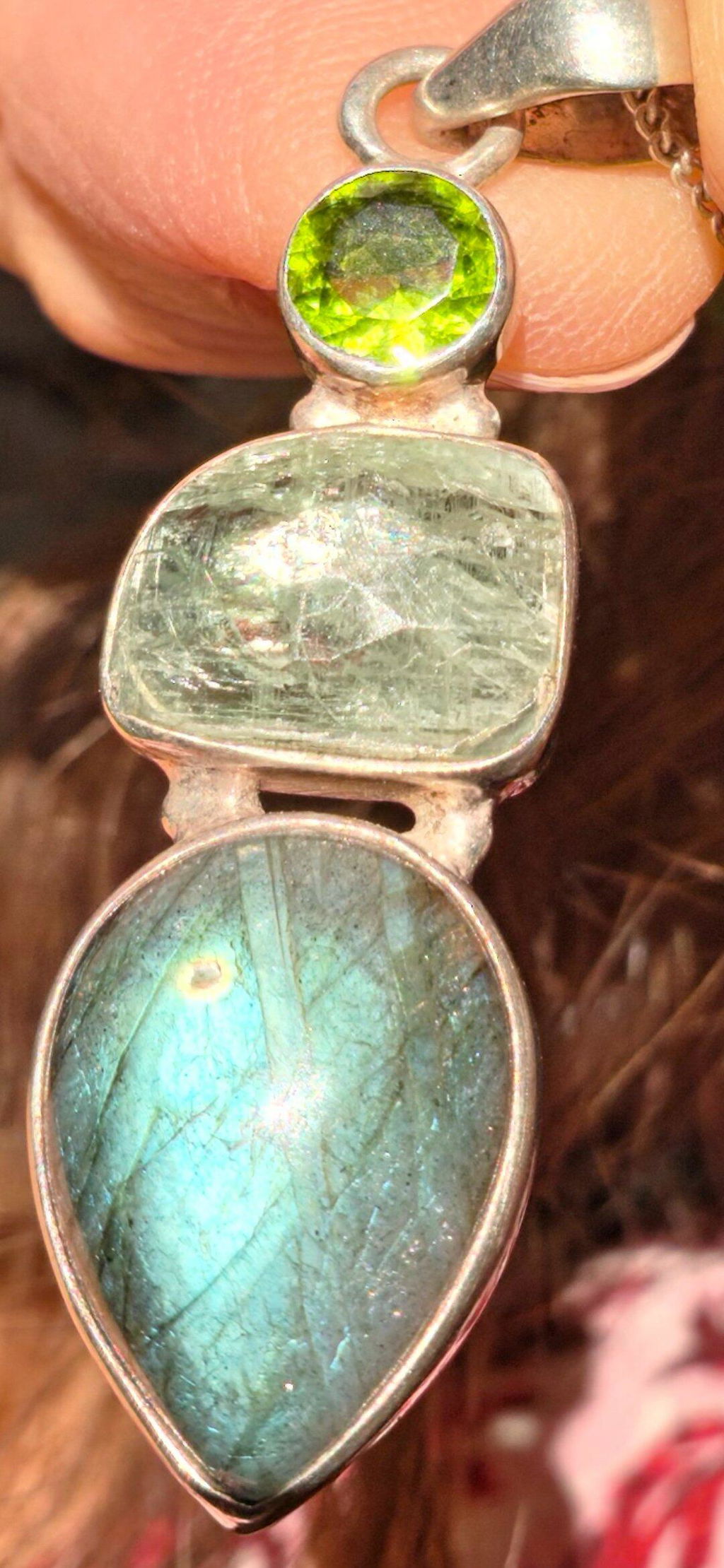
Fair trade handcrafted jewelry is defined as a commercial exchange system that guarantees fair compensation for artisans, respect for working conditions, and environmental protection throughout the entire production chain. Organizations like Equo Garantito certify these principles in Italy, distinguishing authentic products from those that use the term "fair" as a mere marketing label. Every piece of jewelry created within this system carries a story: the artisan's name, the community of origin, the cultural symbol etched into the metal. Choosing a fair trade handcrafted accessory means purchasing a unique piece and supporting an economic model that respects people and the planet.
What materials and processes make a handcrafted piece of jewelry fair trade?
Materials are the primary criterion for assessing the true sustainability of a piece of jewelry. Recycled silver, reclaimed copper, and certified natural stones come from traceable supply chains, where every extraction and processing stage is documented. Traceability of raw materials is the most reliable indicator to distinguish an authentic fair trade piece of jewelry from one that only mimics ethnic aesthetics.
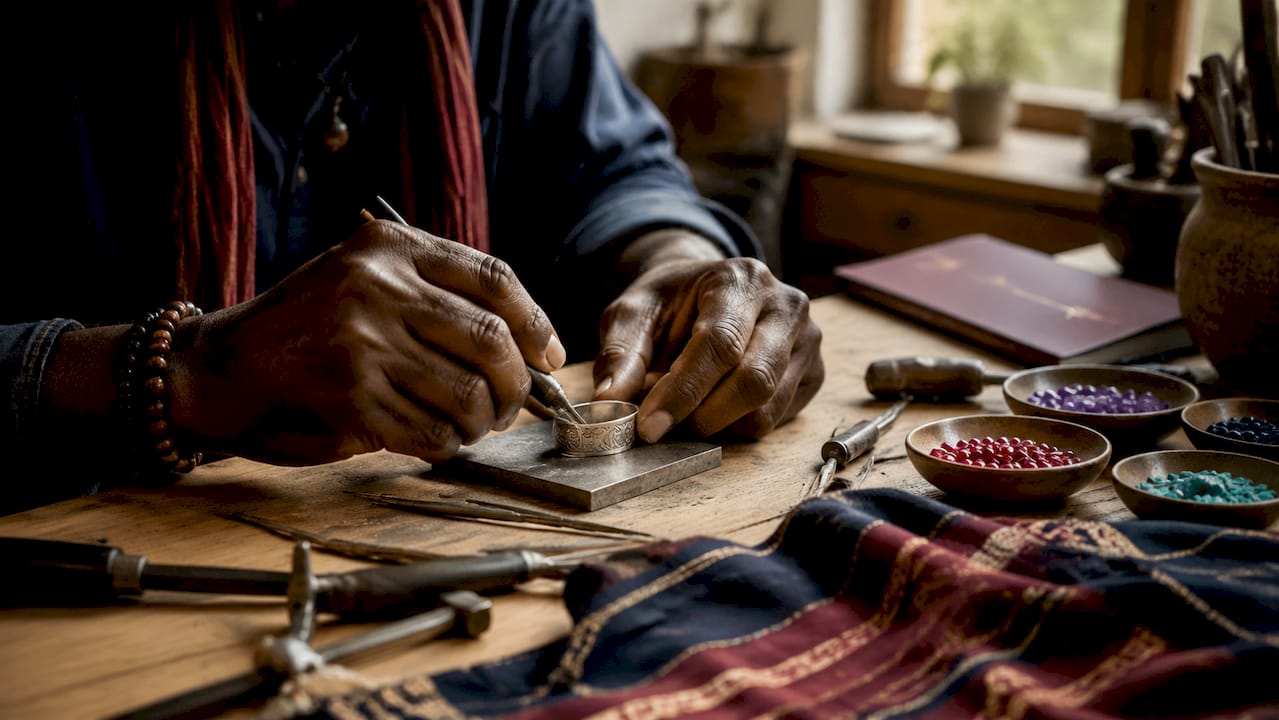
Production processes are as important as the materials. In 2026, industry leaders use up to 90% recycled metals in circular collections, demonstrating that quality and sustainability are not mutually exclusive. This data changes the perspective: it's not about sacrificing beauty, but about optimizing the production chain without waste.
The 2026 Circular Design Framework, developed in collaboration with the Centre for Sustainable Fashion, recommends repairable and versatile jewelry to reduce waste in the sector. A ring designed to last decades and accept replacement stones is worth more than ten disposable rings. This philosophy translates into concrete choices: open settings, modular mounts, finishes that resist daily wear.
A tip: when evaluating a handcrafted piece of jewelry, always ask if the seller can indicate the country of origin of the metal and the provenance of the stones. A fair trade artisan will answer without hesitation.
Packaging also matters. Sustainable jewelry packaging is designed to be recyclable, reusable, and lightweight, reducing CO2 emissions related to shipping. An ethical piece of jewelry that arrives in a single-use plastic box contradicts the values it claims to embody.
Here are the main materials used in ethical handcrafted jewelry and their characteristics:
- Recycled silver: recovered from industrial waste or discarded jewelry, it retains the same properties as virgin silver with reduced environmental impact.
- Certified natural stones: lapis lazuli, turquoise, and onyx from mines with verified safety standards for workers.
- Recycled brass: an economical and durable alloy, used in many traditional ethnic goldsmithing traditions, now recovered from secondary sources.
- Plant-based materials: seeds, FSC-certified woods, and natural fibers often complement handcrafted jewelry from African and South American traditions.
| Material | Environmental impact | Traceability |
|---|---|---|
| Recycled silver | Low | High |
| Certified natural stones | Medium | Medium |
| Recycled brass | Low | High |
| Ethical synthetic stones | Very low | Very high |
How does fair trade empower artisan communities?
Fair trade acts as a cultural megaphone for communities often excluded from traditional commercial circuits. Iranian artisans, for example, distribute jewelry inspired by traditional patterns through fair trade networks, reaching European markets that would otherwise never have known their art. This visibility is not just economic; it is an act of cultural resistance.
Artisan cooperatives in Nepal, India, and West Africa use fair trade proceeds to fund schools, access to clean water, and healthcare in their communities. The jewelry you purchase carries a measurable social impact, not just aesthetics. Every sale translates into concrete resources for those who created the piece.
The preservation of traditional techniques is another direct effect of fair trade. Techniques like Nepalese filigree, Etruscan granulation reinterpreted by Indian artisans, or Tibetan turquoise inlay survive because there is a market willing to pay a fair price for them. Without fair demand, these skills disappear with the generation that knows them. To learn more about the link between ethnic jewelry and cultural identity, Il mondo di Wit has dedicated a specific guide to this topic.
«Fair trade is not just a business model. It is the recognition that every handmade object carries the voice of its creator, the memory of a community, and the right to be heard in the global market.» Altreconomia, 2026
Concrete benefits for producing communities include:
- Wages higher than the local minimum wage, often 20–40% more than the conventional market.
- Access to technical training to improve goldsmithing skills without abandoning traditional techniques.
- Participation in commercial decisions through self-managed cooperatives and collectives.
- Protection for women workers: many fair trade cooperatives are majority female, with explicit anti-discrimination policies.
- Reinvestment of a portion of profits in local community infrastructure.
The initiative involving Equo Garantito for the ethical distribution of works by the Papital Gallery collective demonstrates that this model also works for artists in politically challenging contexts. Craftsmanship thus becomes a tool for economic and cultural survival. Even organizations like Blindenwerkstatt Holger Sieben show how sustainable craftsmanship can include vulnerable communities, transforming manual production into an act of social dignity.
How to recognize quality fair trade handcrafted jewelry?
An authentic handcrafted piece of jewelry is primarily recognized by its imperfections. The variations in colors and shapes are not flaws: they are proof of manual work and the uniqueness of the piece. An industrial piece of jewelry is identical to thousands of copies; a handcrafted piece of jewelry is by definition unrepeatable.
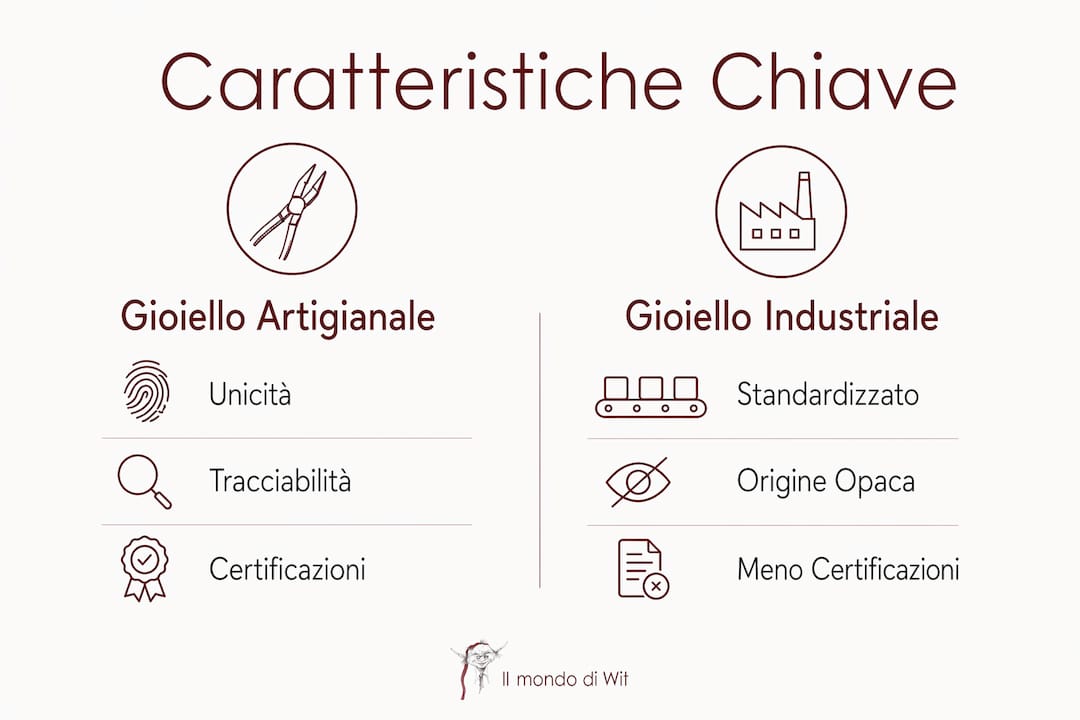
Traceability is the second criterion. A reliable seller indicates the origin of the metal, the name or region of the artisan, and, when available, fair trade certification. Experienced buyers prioritize supply chain transparency as an indicator of real sustainability. Asking for this information before purchasing is a right, not a demand.
Recognized certifications in Italy include the Equo Garantito mark and the seals of the World Fair Trade Organization (WFTO). These standards verify working conditions, compensation, and environmental impact throughout the production chain. A piece of jewelry without any certification is not necessarily dishonest, but it requires greater attention to the information provided by the seller.
A tip: pair an ethnic handcrafted piece of jewelry with neutral clothing to enhance its visual complexity. A silver pendant with lapis lazuli on a white shirt tells its story by itself without competing with other elements.
| Feature | Fair handcrafted jewelry | Industrial jewelry |
|---|---|---|
| Uniqueness | Each piece is unrepeatable | Identical serial production |
| Traceability | Documented supply chain | Often opaque |
| Imperfections | Present and valued | Absent by design |
| Social impact | Positive and measurable | Undisclosed |
| Durability | High, designed to last | Variable, often low |
For those looking for handcrafted brass jewelry, Il mondo di Wit offers concrete examples of unique pieces with a transparent supply chain.
Why are fair trade jewelry pieces a conscious gift?
A fair trade piece of jewelry tells a story that a mass-produced item cannot. When you gift a silver bracelet handcrafted by a Nepalese cooperative, you are sharing the story of its creator, the technique used, and the cultural value it carries. This level of meaning is not found in mass-produced jewelry.
The sustainability of artisanal design also ensures the product's physical longevity. A piece of jewelry designed to be repaired and durable will withstand decades of daily use, becoming an heirloom. The difference from a fast-fashion accessory is structural: one is meant to last, the other to be replaced.
Handcrafted jewelry also offers an artistic and narrative value that allows wearers to stand out from mass production. This aspect is important on special occasions, where a gift should communicate thoughtfulness and uniqueness.
Gift ideas for specific occasions:
- Birthday: a pendant with the birthstone, chosen from Tibetan or Indian goldsmithing traditions.
- Anniversary: a pair of sterling silver earrings with symbols of unity found in Eastern cultures.
- Graduation: a handcrafted rigid bracelet, a symbol of strength and new beginnings in many ethnic traditions.
- Christmas: a necklace with a lapis lazuli pendant, a stone associated with wisdom and protection in numerous cultures.
- Treat for yourself: a turquoise ring, a stone used for centuries as a protective amulet in Tibetan and Native American traditions.
Key points
Fair trade in handcrafted jewelry guarantees authentic quality, positive social impact, and real environmental sustainability only when the supply chain, materials, and certifications are transparent and verifiable.
| Point | Details |
|---|---|
| Sustainable materials | Recycled silver and certified stones reduce environmental impact without sacrificing quality. |
| Mandatory traceability | Always ask for the origin of the metal and fair trade certification before purchasing. |
| Imperfections as value | Artisanal variations attest to the uniqueness of the piece and the manual work behind it. |
| Impact on communities | Fair trade supports cooperatives, preserves traditional techniques, and funds local services. |
| Gift with meaning | A fair trade piece of jewelry tells a cultural story that an industrial product cannot offer. |
The human value that no algorithm can replicate
I have worked with handcrafted jewelry for years and I have learned one thing that catalogs never tell you: the value of a fair trade piece is not measured only by the weight of the silver or the purity of the stone. It is measured by the fact that someone has chosen not to cut costs at the expense of the workers.
I have seen Nepalese artisans produce filigree pendants with tools their grandparents used, sold at prices that finally allow them to send their children to school. I have seen Iranian cooperatives use fair trade to circulate art that would otherwise have remained invisible. These are not isolated cases: they are the direct result of consumers who chose to ask "who made this?" before buying.
My opinion is clear: the market for fair trade handcrafted jewelry will grow in the coming years because the demand for authenticity is structural, not a trend. People want objects that last, that have a story, and that don't cost someone else something. Fair trade meets all three of these needs simultaneously. Those who buy ethical jewelry today are not just making an aesthetic choice: they are voting for a different economic model. Every conscious purchase counts.
— Il mondo di Wit
Ethnic handcrafted jewelry: The Il mondo di Wit collection
Il mondo di Wit selects handmade jewelry in antique silver with ethnic ornaments, chosen for authenticity, metal quality, and cultural significance. Each piece is created by artisans using traditional techniques, without mass production.
In the collection, you will find ethnic pendants in antique silver with hand-engraved ornaments, ethnic earrings in 925 silver with a VEDA design, and handcrafted bracelets in 925 silver with unique rigid workmanship. Every purchase on Il mondo di Wit directly supports artisans who work respecting ethnic goldsmithing traditions. You can browse the entire selection of ethnic handcrafted jewelry directly online.
Frequently asked questions
What is fair trade in jewelry?
Fair trade in jewelry is a system that ensures fair compensation for artisans, decent working conditions, and respect for the environment throughout the entire production chain, certified by organizations such as Equo Garantito or the WFTO.
How do I recognize an authentic handcrafted piece of jewelry?
An authentic handcrafted piece of jewelry exhibits small variations in shape, color, or finish that attest to manual work. The seller should indicate the origin of the metal and, ideally, the name or region of the artisan.
Do fair trade jewelry pieces cost more?
The price is generally higher than industrial products because it includes fair compensation for the artisan and certified materials. The cost difference is justified by the superior quality, durability, and cultural value of the piece.
What certifications guarantee a fair trade piece of jewelry?
The most reliable certifications in Italy are the Equo Garantito label and the World Fair Trade Organization seal. These standards verify working conditions, wages, and the environmental impact of the entire supply chain.
Are fair trade handmade jewelry suitable as a gift?
Yes. Fair trade jewelry carries a cultural history and a positive social impact that an industrial product cannot offer, making it a gift with authentic meaning for any occasion.