Ethnic Necklaces: Spiritual Meaning and Symbolism
In short:
- Ethnic necklaces are sacred objects that carry spiritual meanings passed down for millennia, in addition to their aesthetic value. Mala necklaces, composed of 108 beads, represent temptations and universal energies, and each material amplifies the wearer's spiritual intention. Mediterranean coral necklaces symbolize protection and social status, while Buddhist symbols such as the dorje and the Victory Banner strengthen spiritual power and inner wisdom.
Ethnic necklaces are sacred objects before they are ornamental: every bead, every stone, and every engraved symbol carries a spiritual meaning rooted in millennia-old traditions. From Indian mala necklaces to Mediterranean coral, from the Tibetan dorje to Buddhist turquoise, the spiritual meaning of ethnic necklaces manifests through natural materials, codified forms, and ritual practices passed down from generation to generation. Understanding these meanings is not just a cultural exercise. It is a way to consciously wear what one carries around their neck.
What is the spiritual meaning of Indian mala necklaces?
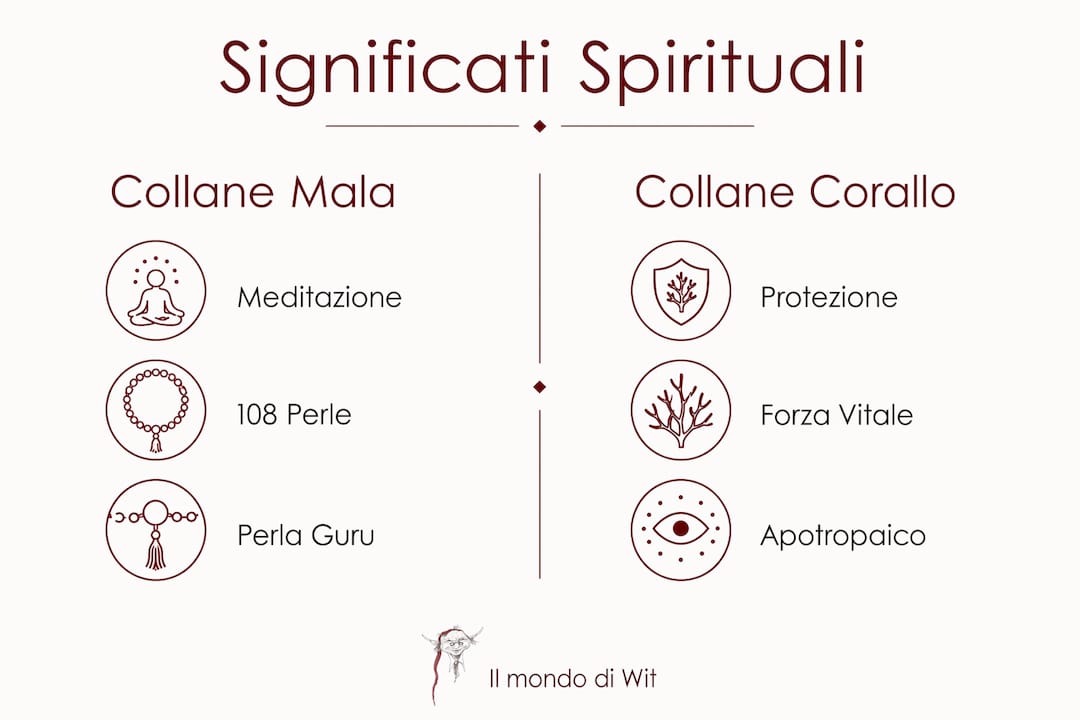
Mala necklaces are meditation tools before they are jewels. Composed of 108 beads plus a guru bead, they represent the 108 human temptations or the universal energy associated with Brahma in Hindu and Buddhist traditions. The number 108 is not random: it appears in Vedic texts, astronomical cycles, and Indian sacred geometry, making each mala necklace an object of precise spiritual intention.
The guru bead holds a special position within the mala. It is not merely a decorative element: it marks the beginning and end of the mantra recitation cycle, representing spiritual guidance or the inner teacher. Passing over it during meditation is considered an energetic error. Correct practice involves reversing the mantra's rhythm and starting again, thus keeping the energetic flow intact.
The materials from which a mala is constructed are not interchangeable. Rudraksha seeds, traditionally linked to Shiva, carry protective and calming energy. Sandalwood promotes concentration and mental clarity. Bodhi seeds, used in the Buddhist tradition, evoke the Buddha's enlightenment under the Bodhi tree. Each natural material amplifies the spiritual intention of the wearer.
Pro tip: When choosing a mala, first consider the meditative intention you wish to support. A rudraksha mala is suitable for protection and devotion; a sandalwood one better accompanies silent meditation and breath work.
Natural materials in mala necklaces include:
- Rudraksha: sacred seeds to Shiva, used for protection and devotion
- Sandalwood: promotes concentration and calms the mind
- Bodhi seeds: symbol of enlightenment in the Buddhist tradition
- Rock crystal: amplifies energy and inner clarity
- Turquoise: stone of protection and communication in Tibetan traditions
The spiritual role of coral necklaces in Mediterranean tradition
Red coral has been an amulet of protection for centuries in Mediterranean cultures. Used as an apotropaic, coral was linked to vital force and the protection of motherhood, with particular attention to women involved in childcare. The intense red color was not chosen for aesthetic reasons: it directly referred to blood, life, and the ability to ward off negative energies.
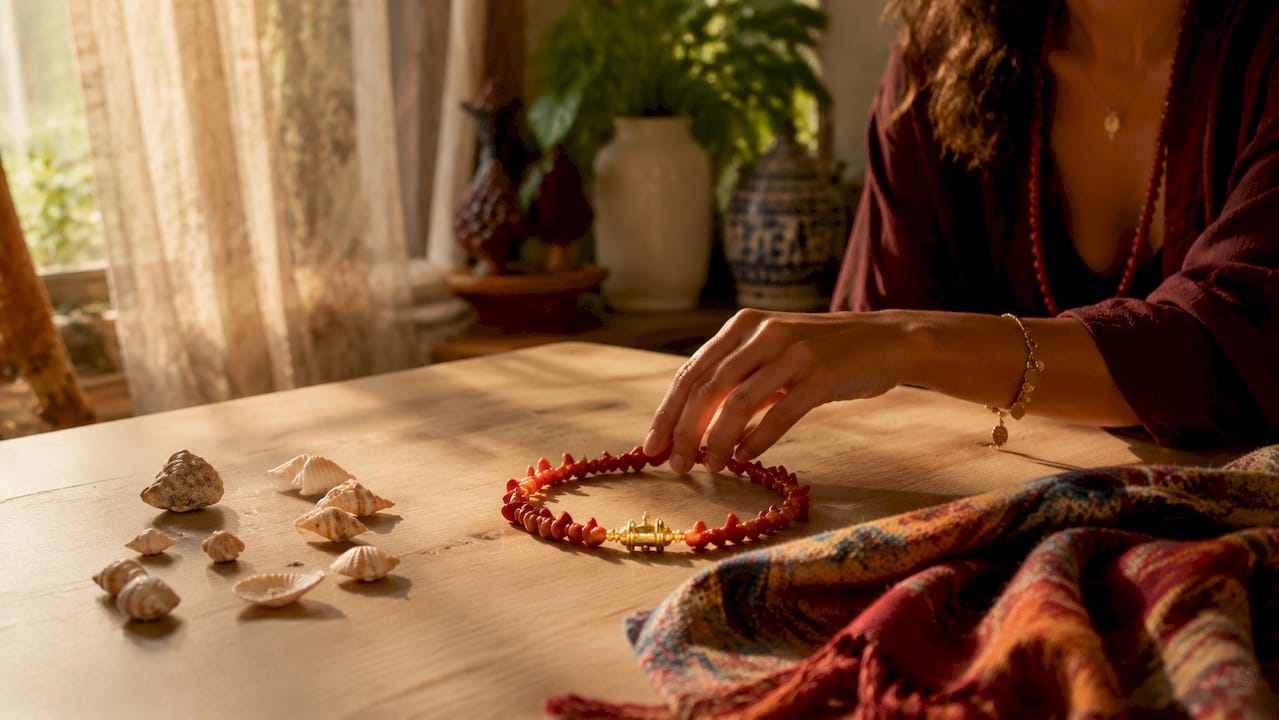
In the Ciociaria tradition, coral necklaces took on an even more precise meaning. Symbols of protection and social status, these necklaces were worn by wet nurses during community ceremonies. The size and quality of the coral communicated the woman's role in the community: an abundant and well-crafted necklace signaled respectability, reliability, and strength.
The social value of traditional coral jewelry went beyond protective symbolism. The ceremonial implications reinforced women's position in the farming community, transforming each necklace into a visible social document. Wearing coral meant belonging to a network of collective responsibility, not just enjoying individual protection.
| Feature | Traditional Meaning |
|---|---|
| Red color | Life force, protection from the evil eye |
| Necklace size | Social status and ceremonial role |
| Workmanship quality | Community recognition |
| Usage by wet nurses | Protection for themselves and entrusted children |
| Twigs vs. round beads | Different shapes for specific apotropaic functions |
Today, coral retains its symbolic charge, but it is reinterpreted as an expression of personal cultural identity. Those who wear a Mediterranean coral necklace carry with them a history of protection, community, and feminine strength that spans centuries.
What do the dorje and turquoise represent in Buddhist necklaces?
The dorje, also known as vajra in Sanskrit, is one of the most powerful symbols in Tibetan Buddhism. It depicts the indestructible power of ultimate reality and is used in ethnic necklaces as a symbolic reminder of spiritual strength and enlightenment. Its shape, similar to a lightning bolt or a stylized diamond, is not decorative: each geometric element corresponds to an aspect of Buddhist doctrine.
The ARUNA necklace in 925 silver with the dorje symbol brings this tradition directly to the neck of the wearer. 925 silver is not just an aesthetic choice: in Tibetan tradition, silver is associated with purity and the moon, amplifying the spiritual qualities of the engraved symbol.
Turquoise holds an equally important place in Tibetan and Buddhist spirituality. A stone of protection, communication, and connection with the sky, turquoise was used by Tibetan monks as an energetic shield during journeys and ritual practices. Its blue-green color refers to the infinity of the sky and the depth of water, two elements associated with wisdom and mental clarity.
The VIZIANAGARAM necklace incorporates the Victory Banner, one of the eight Buddhist symbols, made with 925 silver applications on turquoise. The Victory Banner symbolizes the victory of knowledge and spirituality over negative emotions. Wearing it is not a decorative gesture: it is an affirmation of spiritual intention.
Buddhist symbols present in ethnic necklaces include:
- Dorje (vajra): indestructible strength and spiritual enlightenment
- Victory Banner: triumph of wisdom over negative emotions
- Turquoise: protection, clarity, and connection with the sky
- Endless knot: interdependence of all phenomena
- Dharma wheel: the path to enlightenment
Pro tip: If you are new to necklaces with Buddhist symbols, start with the dorje or the Victory Banner. Both have a clear and direct meaning, and are well suited to support a daily meditative practice even for those without specific Buddhist training.
How to choose and use ethnic necklaces for spiritual purposes
Choosing an ethnic necklace with spiritual intention requires a different approach than buying a simple piece of jewelry. The meaning of the piece must resonate with one's practice or values, not just with one's aesthetic taste. Following these steps helps make an informed choice:
-
Identify the spiritual intention. Do you want protection, mental clarity, connection with a specific tradition, or support for meditation? Each symbol and material responds to different needs. The dorje suits those seeking inner strength; coral those seeking protection; the mala those practicing mantra recitation.
-
Recognize authentic natural materials. Ethnic necklaces made from natural materials like rudraksha, turquoise, coral, and sandalwood carry an energetic charge that synthetic materials cannot replicate. Verify the origin and craftsmanship before purchasing.
-
Study the cultural context of the symbol. Wearing a dorje or a Victory Banner without knowing its meaning reduces a sacred object to an accessory. Take the time to understand the tradition from which your chosen symbol originates.
-
Respect traditional usage rules. A mala is not placed on the ground, not passed to others during meditation, and not worn in places considered impure in the tradition that generated it. These details are not superstitions: they are how tradition preserves the integrity of the symbol.
-
Integrate the necklace into your daily practice. A spiritual ethnic necklace works best when it is part of a routine: wearing it during meditation, keeping it on your nightstand at night, or carrying it during difficult moments strengthens the personal connection with its meaning.
The symbolic value of ethnic jewelry evolves over time. From indicators of social status, they become expressions of personal and individual spirituality. This does not diminish their depth: it means that each generation can find an authentic way to relate to these objects.
Key points
Ethnic necklaces convey precise spiritual meanings through natural materials, codified symbols, and ritual traditions that vary from culture to culture but share the same function: to connect those who wear them to something greater than themselves.
| Point | Details |
|---|---|
| Mala necklaces and meditation | 108 beads and the guru bead structure the mantra cycle with energetic precision. |
| Coral as a Mediterranean amulet | Red coral protects vital force and communicates social status in Ciociaria traditions. |
| Dorje and spiritual strength | The vajra in Tibetan necklaces symbolizes indestructible power and Buddhist enlightenment. |
| Turquoise and Victory Banner | The VIZIANAGARAM necklace features one of the eight Buddhist symbols as an affirmation of wisdom. |
| Conscious choice | Knowing the meaning of the symbol and material transforms a necklace into an authentic spiritual tool. |
The true weight of the symbols we wear
I've worked with ethnic jewelry for years, and what still strikes me today is how often people choose a symbol for aesthetic reasons and then discover, almost by chance, that the symbol says something precise about them. Someone buys a dorje because it's beautiful. Then they read what it means and understand that they were looking for exactly that strength.
This is not a coincidence. Spiritual symbols in ethnic necklaces have a visual coherence that reflects their content: the dorje looks powerful because it was designed to communicate power. Red coral looks vital because for centuries it has been associated with life. The form carries the meaning, even when we don't know it yet.
What worries me, however, is the superficial use of these objects. Wearing a Victory Banner or a mala without knowing what they represent is not necessarily wrong, but it is a missed opportunity. These symbols have a depth worth exploring. And when you do, the necklace stops being an accessory and becomes something that speaks every time you look at it.
Cultural respect doesn't mean you can't wear symbols from traditions other than your own. It means doing so with awareness, curiosity, and gratitude towards the cultures that generated them. This is the difference between appropriation and appreciation. And it's a difference that is felt, even if only in the way a necklace is worn.
— The World of Wit
Handmade ethnic necklaces with authentic spiritual meaning
Those looking for an ethnic piece of jewelry with a true story will find in Il mondo di Wit's offerings pieces built around the symbol, not around fashion.
The SURMA necklace with a brass prayer box brings the Indian tradition of the sacred container directly to the neck, with artisan craftsmanship that respects the original materials. The ARUNA necklace with a dorje in 925 silver translates the most powerful Buddhist symbol into a piece to wear every day. The VIZIANAGARAM necklace with turquoise features the Victory Banner, one of the eight Buddhist symbols, in an authentic Tibetan piece. Each necklace stems from a real tradition and carries a meaning that can be understood, not just worn.
Frequently asked questions
What does wearing a mala necklace mean?
Wearing a mala necklace means carrying a meditation tool: the 108 beads guide mantra recitation and the guru bead marks the spiritual rhythm of the meditative cycle.
Why is coral considered a protective amulet?
Red coral is linked to vital force and protection from negative energies in Mediterranean traditions. In Ciociaria, coral necklaces protected women and children and communicated the social role of the wearer.
What is the dorje in Tibetan ethnic necklaces?
The dorje, or vajra, is a Buddhist symbol depicting indestructible power and spiritual enlightenment. In Tibetan ethnic necklaces, it is used as a reminder of inner strength and mental clarity.
What does the Victory Banner represent in the VIZIANAGARAM necklace?
The Victory Banner is one of the eight Buddhist symbols and represents the victory of knowledge over negative emotions. In the VIZIANAGARAM necklace, it is made with 925 silver applications on Tibetan turquoise.
How do you choose an authentic spiritual ethnic necklace?
The choice starts with intention: identifying the symbol or material that resonates with one's spiritual practice, verifying the craftsmanship, and understanding the cultural context of the piece ensures a conscious and meaningful purchase.